Coming in at number ten on my list of favorite actresses is Drew Barrymore. I've been a fan of hers since probably the sixth grade or so, and so I suppose that has a lot do with my liking her so much, but then again, I think she's quite proven that she is fantastically talented. Granted, she's not somebody that you're going to watch and shout about her performances every time, but every so often, she delivers. And when she's good, she's perfect. I do think that she's more of a "movie star" than an "actress" but she is quickly approaching actress status.
Lionel, Ethel, and John Barrymore
Drew Barrymore is the granddaughter of John Barrymore and the great niece of Lionel and Ethel Barrymore. All three were brilliant performers. Drew certainly inherited that. But the Barrymore family had long been plagued by demons of drug addiction and alcoholism. John, in particular, was a very bad alcoholic who never truly recovered from it. He would die in 1942, a shadow of his former great self. His son, Drew's father, John Barrymore II, also suffered from alcoholism and drug addiction. Sadly, Drew herself become an alcoholic and cocaine addict before the age of fifteen.
She had gotten her big break at the age of six, playing Gertie in Steven Spielberg's E.T: The Extra-Terrestrial. Afterward, Drew became one of the most popular child stars of the 1980s. I think her success came from the ability to play wide eyed moppet roles with genuine talent. With new found success came opportunity. And opportunity released the Barrymore demons. At nine years old, Drew started drinking. At ten, she started smoking pot, and at fourteen became a cocaine addict.
After being released from rehab at sixteen, finding work was a struggle. Drew was stuck in the rut of being too old for children's roles but too young to be a leading lady. The best she could do was small, supporting character roles in low-budget films.
In 1998, Drew teamed up with Adam Sandler for the 80's themed romantic comedy The Wedding Singer. Commercially successful, Drew was back in the spotlight. She then founded her own production company, Flower Films, and in 1999, produced her first film, Never Been Kissed. Again, it was a commercial success and Drew Barrymore established herself as a premier romantic comedy star.
50 First Dates. Can just say I love her hair in this movie?
Many romantic comedies make up Drew Barrymore's filmography. However, she hasn't forgotten her roots as a dramatic Barrymore. It's almost as if people forget that she's a damn fine actress too. Remember Riding in Cars With Boys? She played a character who went from fifteen years old to her mid-thirties. I think that it requires a skilled person to be able to pull that kind of role off. But Drew did. And she was brilliant in it.
There was also Confessions of a Dangerous Mind. Drew played the supporting role of the long-suffering yet infinitely steadfast wife of game show host/alleged CIA hitman Chuck Barris.
However, no other role has displayed Drew Barrymore's dramatic prowess better than the 2009 HBO film Grey Gardens. She played "Little Edie" Beale so well that I found myself forgetting that I was watching an actress in a movie, and not the real thing. Being quite a fan of the original Grey Gardens documentary, I was somewhat wary of watching this film. However, I was absolutely blown away by this film. Drew completely immersed herself in the character so well that it's as if she crawled inside the skin of Little Edie. She did more than portray her; She became her, and won a much deserved Emmy award for Best Actress. I have no doubt that had Grey Gardens been made for a major studio, Barrymore would have been nominated for a Best Actress Academy Award, and would have been quite a strong contender.
I have no doubt that Drew Barrymore will only continue to rise as an actress, and would not be at all surprised if an Oscar comes her way.
On Sunday, a couple of friends from work and myself went out to our local movie theater to see one of my favorite movies, The Lion King---In 3D! Now, I'm not really a 3D freak. I mean, it's fun, and the Terminator 2 3D attraction at DisneyWorld is awesome, but other than that, 3D just really isn't my thing. But when I heard that The Lion King would be re released in 3D, I jumped at the chance to see it.
Although I had spent nearly fifteen dollars on a ticket, it was so worth it for me. Movies are made to be watched on a huge screen, in deafening surround sound, in a darkened theater filled with people all sharing the experience of enjoying a movie. Although I have seen The Lion King more times than I can probably count, watching it in the theater was like seeing it for the first time.
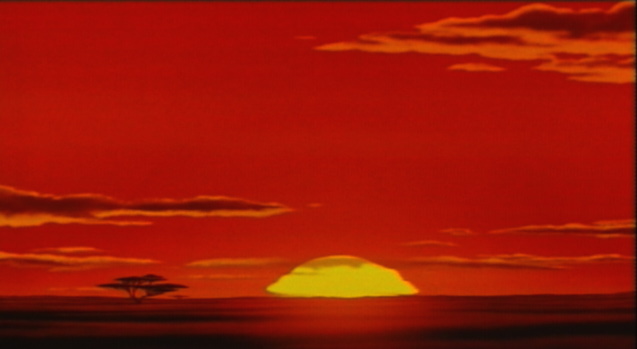
From the opening sequence of the sun rising over the African Savannah accompanied by that incredible African chorus, I was amazed by the realism, the beauty, the colors and sound. I was moved to tears. Not to mention Circle of Life is such a beautiful song.
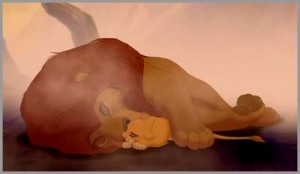
Mufasa's death is even more devastating on the big screen. I don't think I've ever cried harder watching a movie. As I've said before, I have seen this movie many, many times, and Mufasa's death still affects me as if I had never seen it before.I know I've written this before, but I'm quite sure that Mufasa dying is quite possibly the most devastating event in film history. I mean, come on, how can one not watch Simba crawl under Mufasa's paw without bursting into hysterical sobs?
The stampede leading to Mufasa's death was incredible to watch. With the surround sound, you could almost feel the rumbling of the approaching wildebeest. Their thundering hooves were much more menacing as they leaped out of the screen.
The best part of the film in 3D was the climactic fight between Simba and Scar. As if it's not cool enough in 2D being in slow motion and all, the 3D element really rocked here. Scar leaping out of the flames has always been a great part, but in 3D he leaps out of the flames and into your face. It looked awesome.
It's always great to see a beloved movie on the big screen in all its glory. Watching The Lion King (in 3D) in a darkened movie theater, next to friends, sharing such a great movie with a bunch of people, young and old, that I don't even know, was such a beautiful and rich experience that I will look back upon in years to come and cherish.
Last weekend, my friend Corey and I went to South Side Bethlehem to catch a screening of one of my all-time favorite horror films, 1955's Diabolique. Directed by Henri-Georges Clouzot, the film stars Vera Clouzot and Simone Signoret as the wife and mistress of a sadistic headmaster of a boys' school. Fed up with his abuse, the two women team up to get rid of him, once and for all. They drown him and dump his body in the school swimming pool. But when the pool is drained, the body is no longer there. And students claim to be seeing him around the school.
One of the reasons I love this film so much is the build up of suspense and unease throughout. This is not one of those horror films where things jump out and go boo. It keeps you guessing long after the movie has ended. You come to realize that you can't trust or believe anybody. After it's ended, you'll find yourselves looking over your shoulder and jumping at shadows. In my opinion, it's one of the finest horror films ever made, and I think everyone should see it. And be sure to avoid the remake.
Don't be devils! Don't ruin the interest your friends could take in this film. Don't tell them what you saw. Thank you for them.
July 20th, 2011 marked the 73rd anniversary of the birth of Natalie Wood. With a resume consisting of 56 films and three Academy Award nominations, I find it sad how few people seem to remember her today. I think she is one of the most underrated actresses and I can't for the life of me figure out why.
The first time I saw Natalie Wood was in what is probably her most famous film, West Side Story. I was in either eighth or ninth grade, and I remember being struck by how pretty she looked and what a good actress she was. In retrospect, West Side Story was one of my first viewings of classic film and I'm not sure that it's hyperbolic to say that it's a film that changed my life. The library in town had a pretty good selection of movies to take out, and being that West Side Story was among them, I would borrow it quite a few times a month. To this day, whenever I think of summertime, I think of staying up late, sipping on a Vitamin Water, and watching West Side Story. I then decided to learn everything I could about Natalie Wood and see as many of her films as possible.
So, in honor of what would have been her 73rd birthday, I present to you my favorite Natalie Wood films...
Miracle on 34th Street (1947) While this wasn't Natalie Wood's first film, it was the film that really brought her to people's attention. She played Susan Walker, a girl who had been raised not to believe in Santa Claus. However, when she meets a kind elderly man named Kris Kringle who claims to be Santa Claus, she slowly starts to believe. I generally don't like kids in films. I feel like they're usually trying way too hard to impress and they come off as unnatural. However, Natalie Wood was just the opposite- there's nothing fake about her performance. She played the role of a wannabe cynic struggling with a child's innocence. I know for a fact that I've said this about other performances, but I honestly believe that had another child played the role, it wouldn't have been as good. As I've said before, I know that's not an unoriginal statement, but what the hell. It's true.
Rebel Without a Cause (1955) When Rebel Without a Cause is mentioned, one doesn't immediately think of Natalie Wood. After all, it is James Dean's picture- he owns it. But here lies Natalie Wood's greatness- she is able to stand back and let Dean do his thing, while putting in a great performance of her own. Here is another case of great casting. A film about teenagers complaining about how their parents don't understand them is hardly something one would want to watch. But Rebel Without a Cause is different. You feel the actors' angst, anger, and sadness and can relate to it. Thanks to the performances by the young leads, this isn't your typical whiny teen movie. It's something really remarkable.
Gypsy (1962) A lot of things are great about Gypsy. Natalie Wood. Lyrics by Stephen Sondheim. Music by Jule Styne. The dialogue ("Ole, everybody! My name's Louise. What's yours?"). Mostly Rosalind Russell. Who else could have played Mama Rose as well as Rosalind Russell? Nobody, that's who. But I digress. Natalie Wood was more than a match the formidable Roz. She is just as good throughout the film. Playing the role of Louise, the girl who would grow up to be the most famous burlesque dancer in history, Gypsy Rose Lee, Natalie shines. Perhaps it's due to the fact that she was playing a part not too unlike her own life. Her own mother was a failed actress and really pushed Natalie hard throughout her childhood. Throughout her life, Natalie's mother would be an overbearing presence. And so, Natalie's performance is very tongue-in-cheek. Not many people are able to laugh at themselves. Natalie Wood could. That quality really shines through in this film.
West Side Story (1961) As I've previously mentioned, this was the film that introduced me to Natalie Wood. As such, I've always had a soft spot for West Side Story. But rightfully so. It's one of the finest films ever made, and in my opinion, the best musical ever made, behind Singin in the Rain. Although Natalie didn't do her own singing, she still gave a magnificent performance, despite being so awfully miscast. Again, here is yet another testament to her talent. She wasn't a singer, she wasn't a professional dancer, and she sure as hell wasn't Puerto Rican, however her portrayal of Maria is one of the most beautiful and touching performances captured on film, particularly her speech to the warring gangs at the film's conclusion: "How do you fire this gun, Chino? Just by pulling this little trigger? How many bullets are left? Enough for you? And you? All of you, you all killed him. And my brother, and Riff. Not with bullets and guns. With hate. Well I can kill too. Because now I have hate. How many can I kill, Chino? How many? And still have one left for me." Such a performance is, in my opinion, Oscar worthy, but it doesn't really matter, because that same year, Natalie Wood also made:
Splendor in the Grass (1961) This is my absolute favorite Natalie Wood film. Co-starring Warren Beatty and directed by Elia Kazan, Natalie has never been better. She plays Wilma Dean "Deanie" Loomis, a high school senior hopelessly in love with Arthur "Bud" Stamper. The couple assumes they will marry after high school, but peer pressure, parental pressure, and the struggle between sexual expression and repression eventually drive them apart and sends Deanie into a downward mental spiral. This is, in my opinion, Natalie Wood's crowning moment as an actress and while she was nominated for a Best Actress Academy Award, she lost to Sophia Loren in Two Women. If you ask me, this is the worst injustice and biggest mistake the Academy has ever made. (Yes, even worse than giving Sandra Bullock an Oscar). Splendor in the Grass is one of the best commentaries on growing up and the pressures to please parents while trying to explore and experience life for ourselves, and the double standard between the sexes when it comes to sex. All in all, it is a beautiful, tragic, bittersweet, supremely enjoyable movie.
Unfortunately, when you mention the name Natalie Wood to most people today, if you don't get a "Huh?" you will most likely hear about her death. Yes, it was tragic. Yes, it was untimely. The only person who knows for sure exactly how it happened cannot tell us. There are speculations and theories, but they have never been proven. Neither have they been dis-proven. As cliche as it sounds, I think people need to stop focusing so much on how she died and remember how she lived. Of course I would love to see the case solved and if it were to turn up that something fishy did happen, I would love to see justice for Natalie. However, I would rather watch Natalie Wood doing what she did best and worry less about how she left us. To quote Natalie in Splendor in the Grass, "Though nothing can bring back the hour of splendor in the grass, of glory in the flower, we will grieve not; rather find strength in what remains behind"
And what great treasures Natalie Wood left behind.
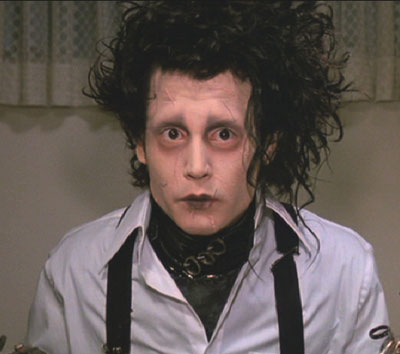
Edward Scissorhands is one of my favorite movies ever. It stars one of my favorite actors, was directed by Tim Burton, one of my favorite directors, has a beautiful score by Danny Elfman, and is one of the best movies to come out of the 90s.
After starring in 1989's Cry Baby, Johnny Depp had finally proven that he wasn't just "That hot guy on 21 Jump Street". He was next cast in director Tim Burton's new project- a story about a man who has scissors for hands. Created by an inventor, Edward (the man's name) is incomplete due to the sudden death of the inventor. He lives all alone in the inventor's castle until one day, struggling Avon saleslady Peg Boggs (Diane Weist) finds him and decides to take him to her house in Suburbia. At first, Edward is accepted by the neighborhood, but eventually circumstances change and he becomes an outcast once more.
At the heart of this movie is Johnny Depp's performance as Edward. Deprived of human interaction, he is completely innocent to the ways of suburbanites. He is wide-eyed, curious, childlike, naive, trusting, gentle and self-conscious all at once. Depp puts such sensitivity into the character and you can't help falling in love with him. He brings to the role both humor and pathos; scenes when Edward is attempting to do normal things such as dressing or eating off a fork for instance make you laugh but break your heart- you know these attempts at normality are futile- no matter how hard he tries, he will never be normal and fit in.
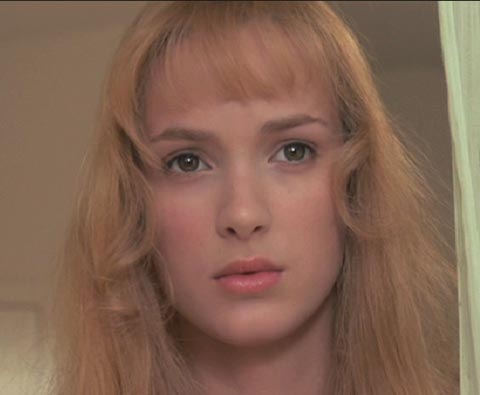
The second essential performance of the film is Winona Ryder's. As the Bogg's daughter Kim, she is at first terrified and repulsed by Edward and is mortified to have any association with him. As the film progresses however, she develops a warm, protective feeling toward Edward which eventually grows into love. Ryder is such a natural performer; she is so sincere and such a fabulous actress. (I'm not sure whatever happened to her).
Other notable cast members include Dianne Weist as Peg Boggs, the Avon Lady, Alan Arkin as Bill Boggs, and Anthony Michael Hall as Kim's brawny jerk boyfriend, Jim. And a cameo by Vincent Price is a treat for a fan of classic horror films.
I love Edward Scissorhands because I feel like it speaks to everybody. All people have something about them that makes them different and stand out from everybody else. I feel like it's a movie that all people can relate to; Everyone just wants to be accepted for who they are. This is a film that definitely speaks to our hearts and emotions and is a true work of art from a true artist.
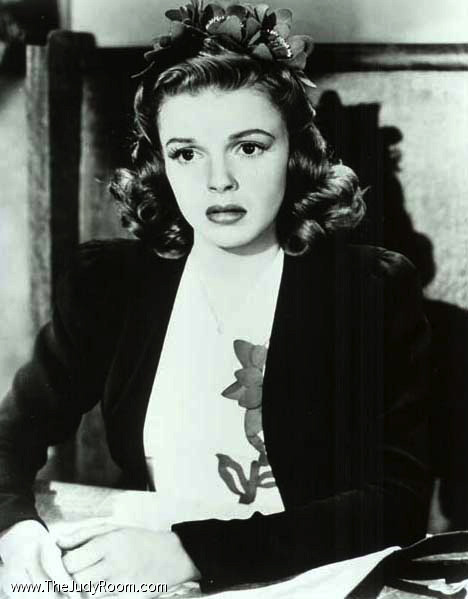
Today marks the anniversary of the birth of quite possibly the most famous entertainer in history. Eighty eight years ago today, in Grand Rapids, Minnesota, Francis and Ethel Gumm welcomed their third daughter, Frances Ethel Gumm. Being the youngest of the family's children, she was immediately nicknamed Baby. Almost as soon as she could walk and talk, she could sing and dance.
At the age of thirteen, she signed a contract with MGM, the biggest studio with the greatest stars. At first they weren't sure what to do with her, and so she spent her first three years at the studio in forgettable movies. Then, in 1939, she was chosen to star in what would become her most well known film, one that would immortalize her and make her known to people all over the world: The Wizard of Oz.
She would stay at MGM until 1950, where her films were hugely popular and successful: Meet Me in St Louis, The Clock, Easter Parade, For Me and My Gal. Well liked by audiences, hers was a regular voice on the radio, singing and cracking jokes with the likes of Bob Hope and Bing Crosby. She toured the country entertaining troops during World War II along with Lucille Ball, Greer Garson, James Cagney, and Mickey Rooney among others.
In 1950, she left MGM to embark on a series of concert tours. This was quite a risky venture. Concerts were considered old fashioned and dull and nobody knew how Garland would be received. They needn't have worried though; the concerts were highly successful and Judy was once again on top. In 1954, she took yet another big risk: She decided to make another movie: a musical version of the 1937 film A Star is Born. Directed by George Cukor, the film ran almost three hours. It was extremely successful and, yet again, Judy was back. She was nominated for a Best actress Academy Award but lost out to Grace Kelly. Groucho Marx called it "The biggest robbery since Brinks".
In 1961Judy made yet another "comeback" when she appeared at New York City's Carnegie Hall. Garland sang, danced, talked with the audience and cracked jokes for two hours. It stayed at number one on the Billboard chart and won four Grammys.
But success wasn't without its price. Since childhood, Judy, along with many others in the industry, were on a steady diet of pills. She was taking Benzedrine during the day to give her increased energy to be able to cope with a long day of filming. Because of these, she couldn't sleep, and so she was prescribed Barbiturates to help her sleep. She soon developed a very serious addiction, to the point where she could no longer function without the aid of pills. Although she had tried on numerous occasions to overcome her addiction, she never could, and on June 22, 1969, Judy Garland died of an accidental overdose of sleeping pills. She was 47 years old.
It's tough for me to talk about Judy Garland and stay neutral. I've loved her since I was in the fifth grade. She is one of my favorite actresses and one of my favorite singers. Listening to her sing really puts me in a better mood and helps a bad day brighten up. I'm not sure what I can say about her that hasn't been said before, but, I really am glad that she was around, if only for a short while. She gave so much and touched more people than she could ever know, and continues to inspire people years after her death.
I'm sure that this post kind of seems out of place, being that it isn't exactly considered one of the finest pictures ever made. But, being that I have quite the soft spot for this movie, being that I have been watching it for as long as I can remember, I decided that it wouldn't hurt to write about 1993's Dennis the Menace.
Based off of characters from a 1950s comic strip, the story centers around the misadventures of a five year old boy named Dennis, his dog Ruff, and his long-suffering neighbor, the elderly Mister Wilson. Although well-meaning, Dennis can't seem to stay in Mister Wilson's good graces. The plot of the movie is somewhat weak; The Wilsons must babysit Dennis while his parents go out of town on a business trip, and the quiet town is disturbed by the presence of a robber. Granted, it isn't the best story, but this is a movie that's not looking to get any prizes; it just wants to entertain. And it certainly does.
The role of Dennis was given to a boy by the name of Mason Gamble. He is so magnificent in this movie. I think it's because he, along with the rest of the cast of children, were allowed to just be kids and play. Gamble brings both innocence and an air of believing that he possesses supreme intelligence often exhibited by small children to his role. Dennis, buddy Joey and tag-along Margaret, definitely get the best lines in the movie. Dennis in particular, is hilarious, especially when he's explaining something that the other kids don't get. Take the children's discussion of parenthood:
Margaret: You know why men are so lousy when it comes to taking care of babies? Dennis: They have better things to do. Margaret: Like what, play golf and drink beer? Dennis: No, like hunting, having wars, driving cars, shaving, cleaning fish. Do you know how to do that? Margaret: If you didn't have women, you wouldn't have babies, which means you wouldn't have people. Joey: If you didn't have men, who'd drive the ladies to the hospital? Dennis: The most important thing is, they marry the women, then the women can go down and get the baby. Margaret: The baby is in her stomach. Dennis: She has to get it installed, her stomach just isn't filled up with babies. Margaret: Who installs them? Dennis: A minister and a doctor.
Upon being questioned on exactly how babies are installed, Dennis informs them that the bellybutton opens up. Margaret then asks him why men have bellybuttons, to which Dennis replies matter- of- factly, "So they don't look weird in bathing suits." I tend to find most children in films to be quite obnoxious. I think it's because they're trying too hard to be actors, rather than just being kids at play. Here lies the brilliance of Dennis the Menace. Producer John Hughes made sure that his actors were normal kids, having a good time and playing with their friends. The kids were relaxed and clearly having a good time.
The second essential aspect to Dennis the Menace is Mister Wilson. The producers had a stroke of genius when they decided to cast Walter Matthau as the archetypal crotchety old man neighbor. He is gruff, sarcastic, acerbic, grouchy, and tender all rolled up into one great package. His performance is balanced by Joan Plowright as his good-natured wife Martha. Although I'm not the biggest fan of Joan Plowrights, I have to admit that I quite like her in this movie, and I think that she compliments Matthau wonderfully and she provides the perfect foil for him. She is particularly touching in a scene when she recites the poem "Winkin' Blinkin' and Nod" to Dennis before she puts him to bed for the night.
The biggest laugh in the entire movie is gotten my Matthau. Unaware that Dennis has knocked the front teeth out of his dentures and replaced them with Chicklets gum, when having his picture taken for the local paper, he gives a big happy smile:
What makes Dennis the Menace enjoyable is its sense of fun. It's not trying to impress, it doesn't take itself seriously, and it just has fun. It really is such a likable film that I have always enjoyed watching.